Skip to content

Named Entity Recognition

Extract named entities (persons, organizations, locations, miscellaneous) from text using a fine-tuned BERT model.

Quick example

try (var ner = BertNerRecognizer.builder().build()) {
    List<NamedEntity> entities = ner.recognize("John works at Google in London.");
    // [NamedEntity[text=John, label=PER], NamedEntity[text=Google, label=ORG],
    //  NamedEntity[text=London, label=LOC]]
}

Full example

import io.github.inference4j.nlp.BertNerRecognizer;
import io.github.inference4j.nlp.NamedEntity;
import java.util.List;

public class NerExample {
    public static void main(String[] args) {
        try (var ner = BertNerRecognizer.builder().build()) {
            String text = "Marie Curie worked at the University of Paris in France.";
            List<NamedEntity> entities = ner.recognize(text);

            for (NamedEntity entity : entities) {
                System.out.printf("%-20s → %s (%.2f%%)%n",
                    entity.text(), entity.label(), entity.score() * 100);
            }
            // Marie Curie          → PER (99.12%)
            // University of Paris  → ORG (98.45%)
            // France               → LOC (97.89%)
        }
    }
}
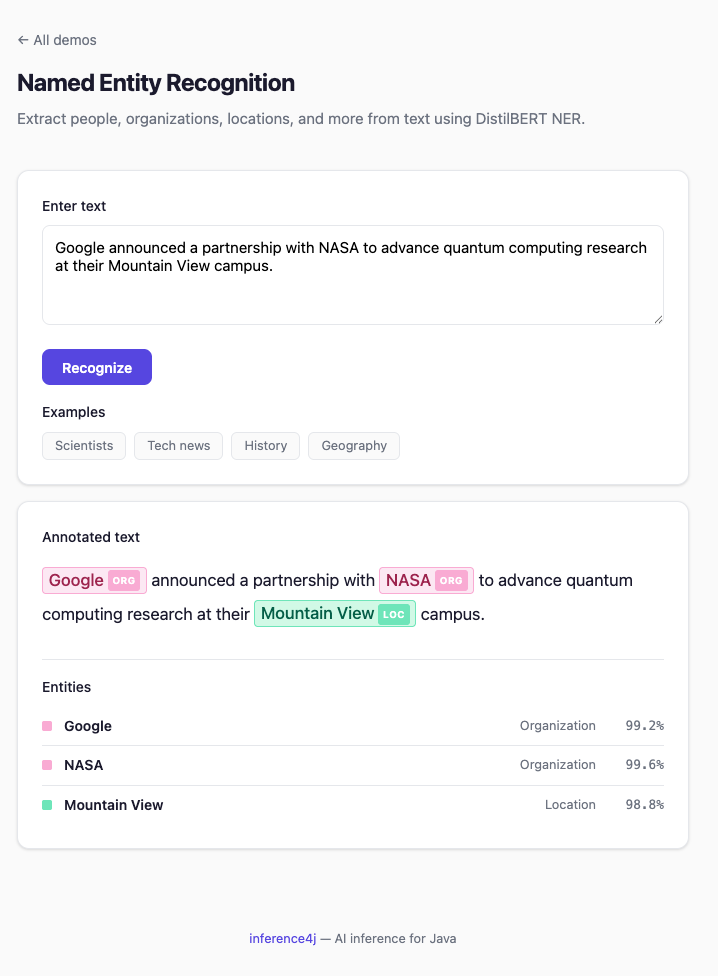
Screenshot from showcase app

Builder options

Method Type Default Description
.modelId(String) String inference4j/distilbert-NER HuggingFace model ID
.modelSource(ModelSource) ModelSource HuggingFaceModelSource Model resolution strategy
.sessionOptions(SessionConfigurer) SessionConfigurer default ONNX Runtime session config
.tokenizer(Tokenizer) Tokenizer auto-loaded WordPieceTokenizer (cased) Custom tokenizer
.config(ModelConfig) ModelConfig auto-loaded from config.json Model config with IOB2 labels
.maxLength(int) int 512 Maximum token sequence length

Result type

NamedEntity is a record with:

Field Type Description
text() String The entity span text (e.g., "London")
label() String Entity type: PER, ORG, LOC, or MISC
start() int Character offset start in the original string
end() int Character offset end (exclusive) in the original string
score() float Mean confidence of the constituent tokens (0.0 to 1.0)

Entity types

The default model uses CoNLL-2003 IOB2 labels:

Label Description Examples
PER Person John, Marie Curie, Leonardo da Vinci
ORG Organization Google, United Nations, NASA
LOC Location London, New York, Pacific Ocean
MISC Miscellaneous English, FIFA World Cup, Nobel Prize

Available models

Model Wrapper Size F1 License
inference4j/distilbert-NER BertNerRecognizer ~260 MB 92.17 Apache 2.0
inference4j/bert-base-NER BertNerRecognizer ~431 MB 91.3 MIT
// Use the larger BERT model for slightly different accuracy characteristics
try (var ner = BertNerRecognizer.builder()
        .modelId("inference4j/bert-base-NER")
        .build()) {
    ner.recognize("...");
}

How it works

  1. Text is tokenized using a cased WordPiece tokenizer (case matters for NER: "Apple" vs "apple")
  2. Subword tokens that belong to the same word share a word ID
  3. The model predicts an IOB2 label for each token
  4. First-subtoken strategy: only the first subtoken's prediction is used for each word
  5. B-* and I-* spans are aggregated into NamedEntity objects with character offsets

Tips

  • The default model is cased — "Apple" (ORG) and "apple" (fruit) are different tokens. Do not lowercase your input.
  • Multi-word entities like "New York" are automatically grouped when the model predicts B-LOC followed by I-LOC.
  • Character offsets (start(), end()) can be used to highlight entities in the original text.
  • For production use, consider the distilbert variant — it's faster with minimal accuracy loss.